
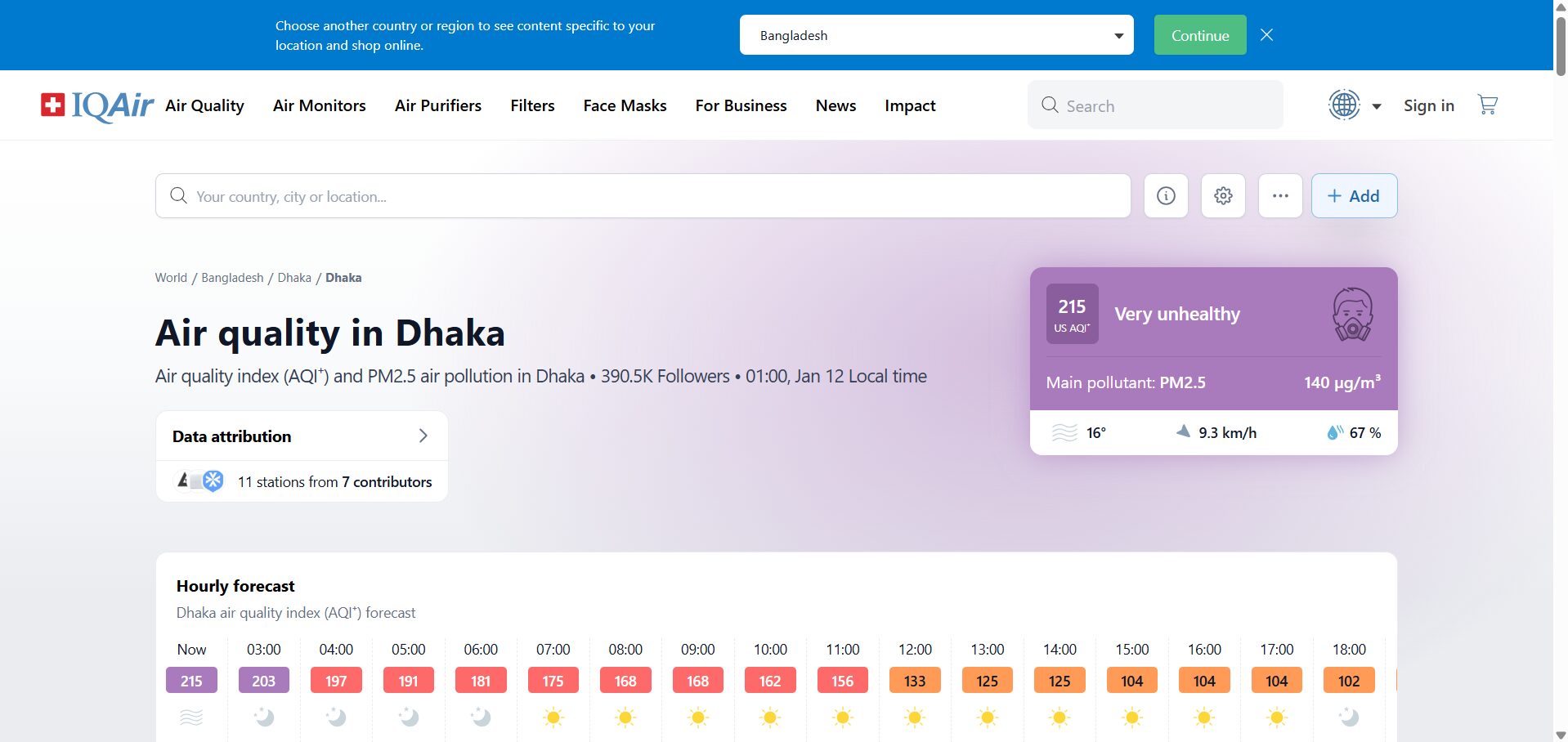
Air pollution has become one of the most pressing environmental and public health challenges in Dhaka, Bangladesh. Every year, the situation worsens during the winter months, and January consistently records some of the most dangerous air quality levels of the year. According to current observations, the Air Quality Index (AQI) in Dhaka in January often ranges between approximately 220 and 330, placing the city in the “Very Unhealthy” to “Hazardous” category.
This level of pollution does not only affect sensitive groups—it poses health risks for everyone, including healthy adults. Understanding what these numbers mean, why January is particularly severe, and how individuals can protect themselves is crucial for residents, workers, and visitors in Dhaka.
Current Air Quality Situation in Dhaka (January)
As of January 12, 2026, air quality monitoring stations across Dhaka and its surrounding areas—such as Dhaka city, Tongi, and Savar—report AQI values ranging from approximately 220 to 330 (US AQI).
Key Air Quality Indicators
- AQI Range: ~220–330
- Health Concern Level: Very Unhealthy to Hazardous
- Primary Pollutant: Fine particulate matter (PM2.5)
At these levels, air pollution is no longer a mild environmental issue. It becomes a serious health hazard, capable of triggering both immediate and long-term health effects.
What Does “Very Unhealthy” AQI Mean?
The Air Quality Index (AQI) is a standardized system used to communicate how polluted the air is and how it affects health.
When AQI reaches 220–330, it falls into the Very Unhealthy to Hazardous range, meaning:
- Health warnings are triggered
- Everyone is at risk, not only vulnerable groups
- The likelihood of adverse health effects increases significantly
- Prolonged exposure can cause serious respiratory and cardiovascular problems
At this level, air pollution can impact health even if the sky does not always appear heavily smoky.
PM2.5: The Main Threat in January
The primary pollutant responsible for Dhaka’s January air crisis is PM2.5, or fine particulate matter with a diameter of less than 2.5 micrometers.
Why PM2.5 Is So Dangerous
- It is small enough to penetrate deep into the lungs
- It can enter the bloodstream
- It can reach vital organs such as the heart and brain
- It can cause inflammation throughout the body
High PM2.5 exposure is linked to:
- Asthma attacks
- Chronic bronchitis
- Reduced lung function
- Heart disease
- Stroke
- Premature death
During January, PM2.5 levels in Dhaka remain persistently high throughout the day and night.
Why January Is the Worst Month for Air Quality in Dhaka
1. Winter Weather Conditions
January’s cooler temperatures can create atmospheric inversion, where polluted air becomes trapped close to the ground instead of dispersing upward. This causes pollutants to accumulate over the city.
2. Lack of Rain
Unlike the monsoon season, January has little to no rainfall, meaning pollutants are not washed out of the air.
3. Reduced Wind Flow
Lower wind speeds in winter prevent pollution from dispersing, allowing fine particles to remain in the air for long periods.
4. Constant Emission Sources
- Vehicle exhaust
- Construction dust
- Brick kilns
- Industrial emissions
- Road dust
These sources contribute year-round, but winter conditions make their impact far worse.
Health Effects of January Air Pollution in Dhaka
When AQI is in the Very Unhealthy to Hazardous range, health risks increase sharply.
Short-Term Health Effects
- Throat irritation
- Coughing
- Shortness of breath
- Eye irritation
- Headaches
- Fatigue
Even healthy individuals may experience breathing difficulty during outdoor exposure.
Long-Term Health Risks
Repeated exposure to high PM2.5 levels can contribute to:
- Chronic lung diseases
- Cardiovascular disease
- Weakened immune system
- Reduced life expectancy
High-Risk Groups During January
While everyone is affected, some groups face greater danger:
- Children – developing lungs are highly sensitive
- Older adults – increased risk of heart and lung complications
- People with asthma or COPD
- Individuals with heart disease
- Pregnant women
For these groups, even short outdoor exposure during high-AQI days can be harmful.
Health Recommendations During “Very Unhealthy” AQI
Given AQI levels between 220 and 330, health professionals strongly recommend the following precautions:
1. Avoid Outdoor Activities
- Avoid all outdoor exercise
- Cancel or postpone outdoor work when possible
- Children should not play outside
2. Stay Indoors as Much as Possible
- Remain indoors during high-pollution hours
- Keep windows and doors closed
- Use indoor air filtration if available
3. Wear a High-Quality Mask
If going outside is unavoidable:
- Wear N95/KN95 or equivalent masks
- Cloth or surgical masks are not sufficient for PM2.5 protection
4. Monitor Health Symptoms
Be alert for:
- Breathing difficulty
- Chest tightness
- Persistent coughing
- Eye or throat irritation
Seek medical advice if symptoms worsen or persist.
Impact on Daily Life in Dhaka
January air pollution affects many groups, including:
- Outdoor workers
- Students commuting to school
- Traffic police and street vendors
- Construction workers
- Elderly individuals running daily errands
Reduced visibility, persistent haze, and respiratory discomfort become part of daily life during this period.
Importance of Monitoring Real-Time Air Quality
Because AQI can fluctuate by location and time of day, residents are encouraged to monitor real-time air quality data through reliable platforms such as IQAir or AccuWeather, or through local monitoring systems where available.
These tools help individuals make informed decisions about outdoor activity and exposure risk.
The Broader Environmental Challenge
Dhaka’s January air pollution highlights wider issues such as rapid urbanization, high population density, fossil fuel dependence, and weak enforcement of pollution control measures. Long-term improvement requires stronger policies, better transport systems, reduced dust emissions, and cleaner energy transitions.
Final Thoughts
Air quality in Dhaka during January is severely polluted, with AQI levels ranging from approximately 220 to 330, placing the city in the Very Unhealthy to Hazardous category. At these levels, everyone is at risk, and protective measures are essential.
While individual precautions reduce exposure, meaningful improvement depends on long-term actions, awareness, and sustained environmental reform. Until then, January remains a critical period when residents must prioritize health, limit exposure, and stay informed.